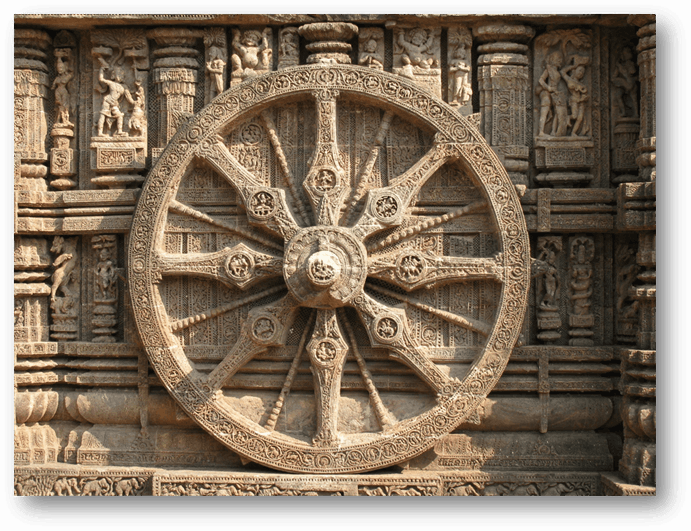
The wheel of Dharma in Konarak, India
🇬🇧 English | 🇪🇸 Español | 🇷🇺 Русский | 🇩🇪 Deutsch | 🇵🇱 Polski | 🇷🇸 Српски
If you have not seen our Welcome page and International Summary in 18+1 languages...
The wheel of Dharma in Konarak, India
🇬🇧 English | 🇪🇸 Español | 🇷🇺 Русский | 🇩🇪 Deutsch | 🇵🇱 Polski | 🇷🇸 Српски
If you have not seen our Welcome page and International Summary in 18+1 languages...
Spirituality is not a hobby. It’s the highest expression of human consciousness.
The English section of Dharma Centrum is not intended as a translation or a full summary of the Hungarian content.
It presents selected texts that function as both a preview of orientation and excerpts of coherent thought.
These writings do not aim at exhaustiveness. They indicate direction, tone, and underlying principles rather than a closed system.
What is offered here is an entry point — a conceptual and experiential threshold — not the full articulation of the teaching.
Dharma Centrum is a contemplative and integrative spiritual initiative
rooted in classical traditions and lived practice.
Its work unfolds at the intersection of:
🌿 spiritual inheritance and contemporary life
🌿 inner transformation and embodied practice
🌿 universal principles and culturally grounded wisdom
Rather than proposing a new belief system, Dharma Centrum seeks to articulate enduring structures of understanding that have accompanied humanity across cultures and eras.

In the East, this path is articulated through
Sanātana Dharma, the eternal divine order.
In the Western spiritual language, it appears as
Universal Christ-centred Faith.
This level represents the common ground, the shared foundation beneath traditions.
It corresponds to the vertical axis of the Dharma Wheel.
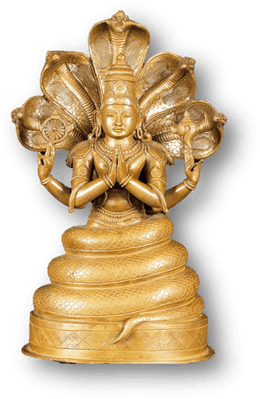
This project unfolds along two complementary dimensions:
Universal Spirituality —
the universal stages of human awakening as articulated by the great traditions of humanity
Hungarian Sacral Heritage —
the path of consciousness as preserved within Hungarian organic culture and inherited tradition
These correspond to the two diagonal axes of the Wheel.

This path concerns how spiritual insight is embodied in the earthly world, through lived practice (sādhana).
It includes both natural ways of living and the restoration of bodily dignity and acceptance.
This corresponds to the horizontal axis of the Wheel.

Alongside this orientation, you will find a small number of essays
— not as conclusions, but as open contemplations.
What follows is not meant to persuade, but to orient
— leaving space for reflection and lived understanding.
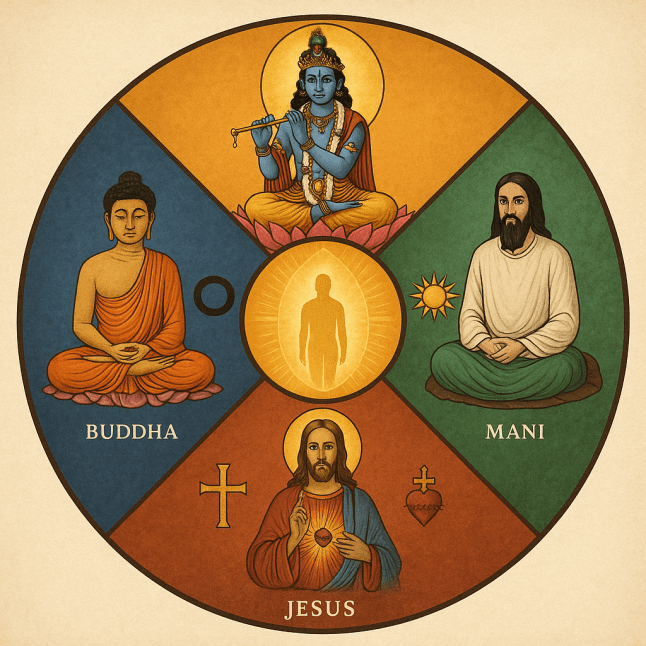
Jesus Christ stands at the center of many spiritual traditions not because he claimed territory, but because he embodied a state of being. He did not primarily deliver a system of belief; he transmitted a mode of existence in which divine love, humility, and self-giving became visible in human form.
Within the perspective of the Dharma Centrum, Jesus is not approached as an exclusive religious figure, nor reduced to one master among many. He represents a central axis: the point where the Absolute does not merely instruct, but enters history and relationship. His uniqueness lies less in doctrinal claims and more in the quality of presence he manifests—grace lived, not explained.
Western Christianity has often expressed this through theological exclusivity; Eastern Christianity through transformation and deification; ancient Eastern churches through a cosmic and healing Christ; the Gnostic tradition through awakening and remembrance. These languages differ, yet they circle the same recognition: in Jesus, the divine and the human meet without distance.
This is why parts of the Vedic tradition also recognize him. Yogic masters such as Paramahansa Yogananda did not honor Jesus out of syncretism, but out of realization. They perceived in him an avatar-like consciousness—a being established in God-realization, expressing divine love through surrender rather than power. In yogic terms, Jesus unites jnana (true knowledge) and bhakti (total devotion) in lived form.
In the Dharma Centrum’s spiritual map, Jesus therefore occupies a central, non-exclusive role. Around him stand other great realizers—Krishna, Buddha, Mani—each representing a distinct gateway of realization. Yet Jesus functions as the vertical bridge: from the Absolute to the human heart, from transcendence to intimacy.
He is not the center because others are denied, but because grace itself becomes personal through him.
In this sense, the Dharma Centrum does not proclaim a religion, but acknowledges a spiritual fact:
Where love becomes flesh, humility becomes strength, and surrender becomes freedom, there stands Jesus.
Where grace takes form, the center appears.
Beyond belief, toward realization.
Where traditions meet at their source.
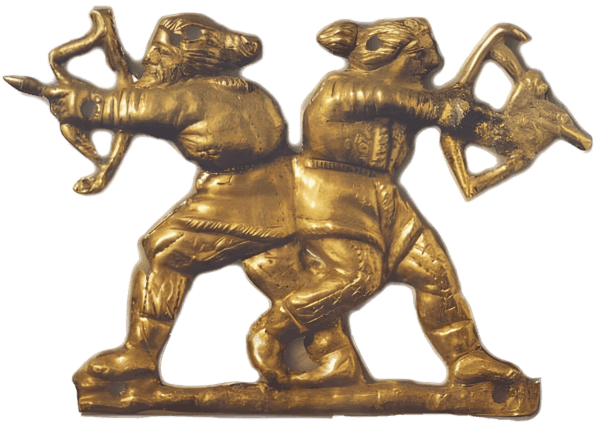
An inquiry into ancient spiritual bonds, where Scythian heritage, Vedic order, and Gnostic community converge.
The Scythian spiritual ideal of háttárs—the sanctity of a given word, shared responsibility, and standing for one another—resonates with striking clarity in both Vedic dharma and Gnostic teachings. What our ancestors lived through Scythian, national, and folk ritual orders was not merely an archaic religious form, but the expression of a timeless, sacred way of life. Its deepest layers reappear, almost untouched, in the Vedic vision of cosmic order and in the Gnostic ideal of a community of awakened souls.
The Scythian concept of háttárs—mutual protection, fidelity to truth, readiness for self-sacrifice—stands close to the Vedic sense of spiritual brotherhood and the Gnostic awareness of communal soul-unity. All three traditions place the highest value on the spoken truth, inner order, and spiritual loyalty. They recognize one primary law: a living law that does not coerce from outside but binds from within. Truth here is not doctrine, but bearing. Not a lesson, but a stance.
Conflict, in these traditions, is never an end in itself. Struggle serves the defense of sacred order: Arjuna’s battle under Krishna’s guidance, the Gnostic soul’s resistance to the illusions of the world, and the Scythian’s steadfastness all point in the same direction—faithfulness to the Light in a world grown confused.
For this reason, the Scythian legacy is not a sealed relic of the past but a living, universal message. It is not an ethnic memory, but a human possibility: how a person lives when they still know why a word is given—and why one stands for another.
History, however, does not only preserve; it also distorts. What was once life, love, and covenant gradually hardened into power, guilt, and fear. Sacred order was replaced by institution, inner law by external compulsion, and good news by a cult of suffering. It was not the teaching that decayed, but its transmission: the living spring was confined within stone channels.
Yet what was once true does not expire. The seed did not die—it was only buried.
“They tried to bury us. They did not know we were seeds.”
— Gábor Géczy
In this sense, the Primordial Covenant is not a mere prefiguration of the New Covenant, but its real foundation: a living covenant of love that precedes all written law. Only such a timeless and universal primal covenant can counterbalance the chaos that arises when every level of life is drained by the thirst for power and self-interest. More concretely: the conscious re-activation of this primordial covenant—historically a true preparation for the New Covenant—is capable of saving our world from the devastation caused when global resources are exhausted at any cost by parasitic leadership structures.
Researcher Lajos Bíró expressed this insight with stark clarity:
“The Sanctity of Love is the true teaching of Jesus—just as the equal-armed cross was once the ancient symbol of the union of the sexes, later replaced by pseudo-Christianity with an instrument of execution. Instead of good news, the cult of torture and suffering prevailed.”
Yet all this is not accusation, but recognition—and task. Renewal is not an ideological revolution, but a practical act of remembering. A sacred community is not an institution, but a living covenant: trust between people, a kept word, and responsibility carried together. Order is reborn not in grand systems, but in small circles.
If even a single such sacred seed takes root in each settlement, it is no longer utopia, but a network. It does not dominate—it sustains. It does not build power—it gives backbone. Thus the inheritance of the past can become the foundation of the future—not as regression, but as fulfillment.
“City of Love and Village of Joy,” writes Csaba Varga.
And indeed—may as many seeds as possible break the soil and rise.
Arkadaş (Turkic) and háttárs (Hungarian) denote more than friendship or companionship; they express an ancient covenantal bond rooted in mutual protection, fidelity, and shared destiny.
In the Turkic tradition, arkadaş originally meant “one who covers your back.” It referred to a person with whom one stood side by side in life and in danger—someone entrusted not merely with loyalty, but with one’s very survival. The bond implied reciprocal responsibility, truthfulness of word, and readiness for self-sacrifice. An arkadaş was not chosen for convenience, but recognized through trial.
The Hungarian concept of háttárs preserves the same primordial meaning with striking clarity. Literally “the one who stands at your back,” a háttárs is the person who safeguards you when you face forward—who carries responsibility without supervision, who holds the line when no witness is present. In Hungarian organic culture, this bond was not contractual or emotional, but ethical and existential. A broken word toward one’s háttárs meant the collapse of personal integrity.
Across both traditions, arkadaş / háttárs represents a living moral alliance:
not friendship, but standing-for-one-another;
not hierarchy, but shared responsibility;
not ideology, but embodied trust.
The Primordial Covenant (Ősszövetség) is the original, pre-institutional bond between human beings and the sacred order of life. It precedes all written law, formal religion, and historical doctrines. Its essence is not commandment, but commitment; not obedience, but fidelity.
This covenant lives wherever the spoken word is sacred, responsibility is mutual, love is active, and inner law governs action. It is a covenant of living truth, transmitted not primarily through texts, but through embodied culture, ritual, and communal ethics.
The Primordial Covenant has been preserved in fragments by many ancient peoples; however, it survived with exceptional continuity and coherence within Hungarian organic culture, where it remained embedded in language, folk customs, moral codes, and communal structures long after it had hardened into institutions elsewhere. Hungarian tradition did not merely remember this covenant—it lived it.
In this sense, the Primordial Covenant is not a symbolic forerunner of the New Covenant, but its ontological ground: the living soil from which later revelations could emerge. Where the Primordial Covenant remains active, renewal does not require revolution—only remembrance and practice.
The bond of arkadaş / háttárs is one of the clearest human expressions of the Primordial Covenant. It translates cosmic order into lived human loyalty. Where such bonds exist, covenant is not preached—it functions.
A community built upon háttárs relationships does not need heavy institutions, external enforcement, or ideological control. Its order arises from within, sustained by trust, truthfulness, and shared responsibility.
Where these bonds disappear, covenant collapses into law, and law into power.
New Testament vs. New Covenant
In most international usage, New Testament is understood primarily as a canonical book collection—a defined body of texts forming the second part of the Christian Bible. The emphasis lies on scripture, authorship, and doctrinal continuity.
Within Hungarian organic culture and its spiritual inheritance, the emphasis has traditionally been different. What is central is not the Testament as a written corpus, but the New Covenant as a lived reality. For us, covenant (szövetség) precedes text. Life precedes law. Relationship precedes doctrine.
Thus, what many cultures primarily approach as the New Testament, Hungarian tradition has most deeply received as the New Covenant: a renewal of the primordial love-based alliance between human beings and the divine order, enacted through lived faithfulness rather than textual adherence.
This difference is not theological opposition, but difference of emphasis:
Testament points to what was written.
Covenant points to what is lived.
Primordial Covenant and New Covenant
From this perspective, the New Covenant is not a rupture from the past, nor merely the fulfillment of prophecy, but the reactivation of the Primordial Covenant under historical conditions of crisis and distortion. Jesus does not introduce a new moral system, but restores covenantal life: trust, love, inner law, and responsibility lived among people.
The New Covenant, therefore, does not abolish the Primordial Covenant—it brings it back into conscious visibility.
In contemporary usage, religion is commonly understood as an institutional system: doctrines, hierarchies, moral regulations, and formal affiliation. This meaning, however, is historically secondary.
The older and deeper concept is religio—from the Latin re-ligare, “to bind back” or “to reconnect.” In this original sense, religio refers to a lived attentiveness to sacred order: a careful, conscious orientation of life toward truth, responsibility, and meaning. It describes practice before belief, relationship before system.
What later became organized religions were originally closer to what we might today call confessions: shared ways of acknowledging and living according to a perceived sacred truth. A confession was not primarily a structure of control, but a communal form of faithfulness—embodied in custom, ethics, and daily conduct.
Hungarian organic spirituality historically aligned far more with religio and confession than with institutional religion. Faith was not administered; it was lived. Covenant was not enforced; it was kept. The sacred was not separated from life, but woven into it.
Understanding this distinction helps clarify why, in this tradition, covenant takes precedence over testament, and lived alliance over formal belief. What matters most is not adherence to a system, but fidelity to a relationship—between human beings, and between humanity and the sacred order itself.
When covenant is reduced to testament, life becomes doctrine.
When religion becomes institution alone, confession loses its voice.
Reclaiming covenantal language does not reject Christianity—it clarifies it. It brings the focus back from systems to relationships, from enforcement to fidelity, from belief about truth to living in truth.
This is not a return to the past, but a recovery of depth—one that many ancient cultures remembered in fragments, and which Hungarian organic culture preserved with exceptional continuity.
What is commonly called the New Testament internationally is, in Hungarian organic tradition, understood most deeply as the New Covenant: not primarily a collection of texts, but a lived renewal of a love-based bond between human beings and the sacred order of life.
This covenant precedes scripture and institutions; it is enacted through faithfulness, responsibility, and lived truth.
Religion here does not originally mean a system of control, but a shared confession—a way of living in conscious relationship with the divine.
The New Covenant restores the primordial covenant that many ancient peoples remembered, and which Hungarian culture preserved with exceptional continuity.
If these themes resonate,
you are welcome to explore further — slowly, attentively, without haste.
Some dimensions of this work are available only through personal engagement and lived practice, beyond what any text can fully convey.
For more information get in touch with us at: dharmacentrum@pm.me
Dharma Centrum
Rooted. Open. Oriented.
The Dharma Centrum is a meeting place where timeless wisdom becomes lived experience, and diverse traditions converge at their shared source.

River Kurca, Szentes, Hungary

Drag & Drop Website Builder